Jul 05 2008

Handy Tips 3. (of 3)-Installing decorative exterior shutters.

Tag: Helpful, Tips and Tricksadmin @ 2:10 pm

Handy Tips 3. (of 3)

Installing decorative exterior shutters.

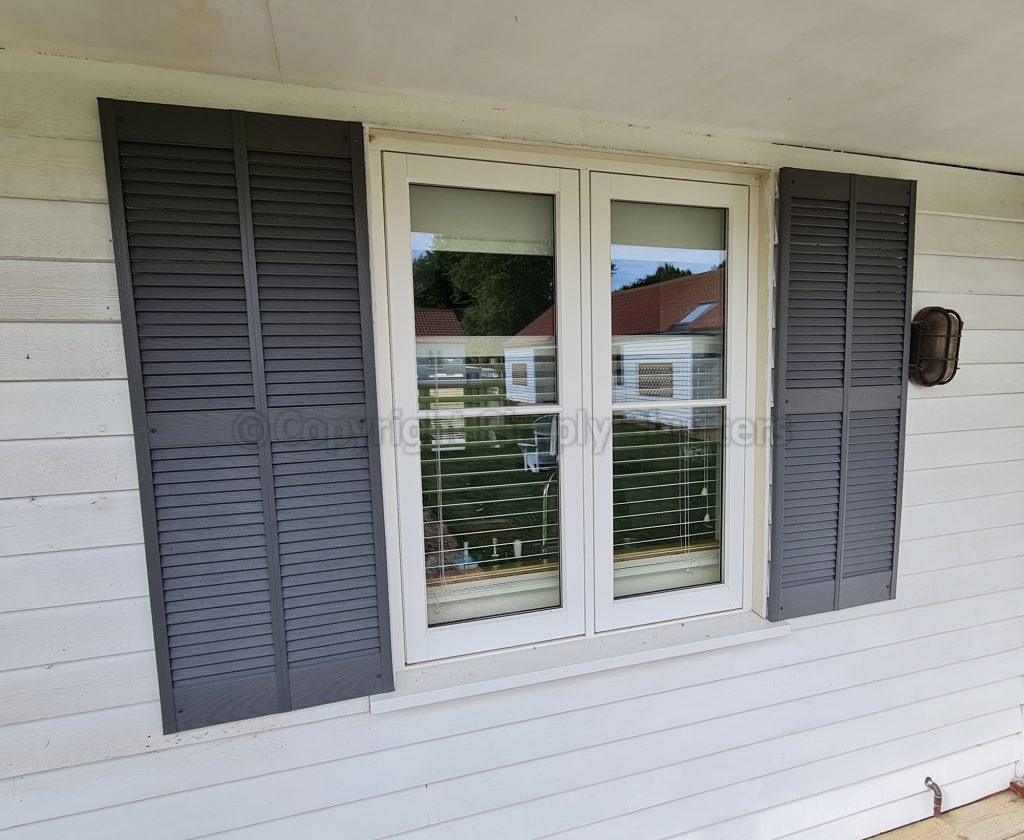
Putting your new shutters up on the wall.

Having gone through all the trials and tribulations to get to this point, the moment is at hand where you (and everyone else for that matter) can see the fruits of your labour. It is time to install your shutters!

Simply Shutters products are made from Duraprene, a polypropylene composition that gives the shutters a weather resistant finish that will keep them looking good for years. Polypropylene is what some garden furniture, plastic buckets and car bumpers is made from. As a consequence they are quite flexible in your hands but become very rigid and stable when positioned on a solid surface.

The wall does not need to be completely flat as the shutters will find their own level. As a consequence fixing shutters to walls that are: rough stone, stucco finished, pebble dashed, roughcast, ship lapped or use siding presents no problem at all.

You will need to insert the Shutter Spikes into the pre-drilled holes in the shutter first as this is much easier done on the ground than up a ladder. If you are using screws then insert the wall anchors (Rawlplugs (TM)) into the holes in the wall and tighten the screws. If using Shutter Spikes then locate the tips into the holes into the wall and gently (remember that you are not driving in a railway spike) tap the spike in.

Do not over tighten the spike or screw as the shutters will expand on a warm day. If the fixings are too tight you will end up with dimples or saucer shaped dents around the heads that will look horrible. As the shutter cools the dimples will go away but will come back again when expansion next occurs. You should look to leave about a 1mm expansion gap between the face of the shutter and the underneath of the plug head or screw head to avoid this happening.

Clean the shutters with warm soapy water and a brush (it’s easier than with a cloth) and never, ever use solvents, bleach or cleaning fluids on them.

So, to summarise the points discussed so far are:

1.    Make small marks on the wall to enable you to accurately re-align the shutters.

2.    Align the shutters with the window and do not use a spirit level.

3.    Mark out the fixing positions on the shutter.

4.    Drill the holes in the shutter.

5.     Position the ladder to support the shutter or use a nail to support one corner of the shutter

6.    Mark out the positions for the holes in the wall.

7.    Use the correct drill bit for the material you are drilling into.

8.    Check for correct size of the finished hole.

9.    Either enlarge or pack out the hole if required.

10.    Install the shutters remembering to leave a small 1mm expansion gap.

I hope that you find this information useful. If you will care to leave any comments about any particular problems you came across and any new tips that you can suggest so that I can pass them on to others I should be most grateful.


Jul 01 2008

Handy Tips 2. (of 3) -Installing decorative exterior shutters.

Tag: Helpful, Tips and Tricksadmin @ 2:18 pm

Handy Tips 2. (of 3)

Installing decorative exterior shutters.

Drilling the shutter installation holes.

Brickwork and Masonry Walls.

Try not to drill into pointing unless you have a wall constructed from engineering bricks. I’ll deal with this matter later on.

Pointing can be extremely variable in consistency and the finished hole can end up being much bigger than the drill bit, particularly if the composition is soft and sandy. Unless you have no option, we always recommend drilling into solid brickwork.

Some bricks are very soft whilst others such as engineering bricks are very hard indeed. Test the brickwork by drilling a hole directly behind where the shutter is to be located and see if the wall anchor (Rawlplug (TM)) or Shutter Spike fits snugly into the hole.

If the brick or material you are drilling into really is tough work then you might want to consider drilling into the pointing as an alternative. Test the pointing for consistency and select the appropriately sized drill bit (you might need a slightly larger drill bit for hard, ungiving material and a smaller drill for softer compositions.

If using a Spike, it should bite as it is gently tapped into the hole. If the hole is too big the spike will not grip and pull out easily. If it is too small the spike will bend as you tap it in. Use a slightly bigger or smaller drill bit depending on the situation. The same rules apply to wall anchors. The wall anchors should fit snugly and not pull out of the wall when you screw into them.

If you are like most people and have a small selection of drill bits at your disposal don’t worry! If the hole needs enlarging a fraction just wriggle the drill bit in the hole when drilling to enlarge the hole. If the hole is too big, then take a small shaving of wood and place it next to the spike and then tap both shaving and spike into the hole. The shaving will take up the slack and provide a secure fixing to enable the spike to grip. I have found that you can also use this technique with wall anchors such as rawlplugs(TM)

Timber Walls.

One potential problem that you will need to consider when drilling into a timber frame or timber wall is moisture/ water ingress. Water ingress can be serious and extremely damaging so all precautions should be taken to prevent water entering the timber.

If using a screw fixing, a small dab of clear silicon on the tip of the screw will form a water tight seal around the hole. Don’t apply too much silicon as this will make a dreadful mess. Apply just enough so that as the screw thread enters the wall it squeezes the silicon up along the shank.

Shutter Spikes are self sealing because the thread on the shank is barbed and backward facing rather than spiralled. As a consequence no water will run down into the hole. That said, the hole still needs to be the right size and particular care must be taken to use the right sized drill bit. In an emergency, where the drilled hole is too big, use a small amount of waterproof silicon sealer as described above.

Tiles and Slate.

If I had a penny for every time I had to answer the question of whether our decorative shutters can be hung on tiles I think I would be very wealthy by now. In short, the answer is yes but with obvious reservations.

Tiles can be fixed to a wall in many ways and it is not advisable to secure shutters to tiles that are purely hung and not fixed to a wall. The reason is obvious; when the wind blows there is a risk that the shutter will take the tile off the wall.

Most tiles are secured onto wooden battens, some however are not. Either way you must drill through the tiles and secure a fixing into the wall or batten behind the tile. Fixing into battens can be awkward as you will not know where the battens are positioned and this is a situation that you must overcome by carefully locating the battens and if need be, adding further battens so as to be able to get a secure fixing. Not an easy job but one I consider more tricky than difficult. Where there is a wall behind the tile, you will need some particularly long screws but otherwise the task is far more straightforward.

To drill a hole into a tile do not use a masonry drill bit; this will only crack the tile. You must also remember to turn the hammer action on the drill to off. Only use a drill bit designed to cut holes in porcelain or ceramic tiles. These specialist drill bits can get very hot when in use and the cutting edge can easily wear off. As the bits are not cheap to replace I would recommend that you go very slowly indeed and use a water spray every few turns to cool the drill bit down. It is slow work but you will get there in the end. Once through the tile, drill into the batten or wall (use a wall anchor if required), position your shutter and screw home.

Now go to Handy Tips 3 for the next stage.


Jun 24 2008

Handy Tips 1. (of 3) -Installing decorative exterior shutters.

Tag: Helpful, Tips and Tricksadmin @ 2:18 pm

Handy Tips 1. (of 3)

Installing decorative exterior shutters.

Positioning the shutter and marking out.

These notes are intended as an accompaniment to the installation instructions supplied.

Simply Shutters supply installation fixings as standard with all UPVC decorative shutters. There is the choice of a coloured keyed mild steel screws or a plastic plug that takes the place of the screw called a Shutter Spike.

The first thing to consider is where to locate the shutter. Some people prefer the inner edge of the shutter to be up close to the edge of the window reveal whilst others prefer for there to be a gap/ space of whatever dimension they choose. This is purely subjective and depends on what you think looks best.

Having decided where to position the shutter, use a wax crayon (or something easily visible) and make to some very small ‘L’ shaped marks at the outer corners of the shutter. This is to help you reposition the shutter later on should it slip whilst marking out the hole locations on to the wall. The shutters are not heavy but it can be awkward to hold the shutter in position with one hand whilst marking with the other. Remember, if you drill the holes in the wrong location then the shutter will look askew when installed so this is a really important task to get right.

The next stage is to check for any obvious reasons why a hole cannot be positioned where you might want it? There can be a variety of different obstacles such as existing holes, particularly large wall irregularities, cables and so on. There is a great deal of flexibility when it comes to the position of fixing holes in the shutter, so if there are obstacles, make a small mark on the side edge of the shutter away from the obstacle and position the holes accordingly.

Align the shutters to the window reveal edge. If your window is not square than your shutters must match and align to it or it will look very odd indeed!

Having decided where on the shutter you will drill your holes, make a mark at the desired locations in the 4 corners (ideally about 3 or 4 inches in from the top and bottom edges) and avoid the support brace on the back of the shutter. Now make a small hole in each of these marks with a nail or bradawl to minimise the risk of the drill bit slipping. Use an HSS drill bit (not one for masonry or timber) to drill a clean hole into the shutter the same size as the hole you will drill in the wall.

You will need the correct drill bit for the fixing chosen and you will need to refer to the installation instructions for this. If you are using screws make sure that the holes that you have drilled are smaller than the heads of the screws. An obvious statement I know, but an easy thing to forget or get wrong!

What is an HSS drill bit do I hear you ask? There a various different types of drill bit head but the three most common are:

HSS (High Speed Steel) drill bit: Commonly used for drilling into both wood and metal. This is what most of us think of when we imagine a drill bit head.

Wood drill bit: Can only be used on wood. This drill bit flat shoulders with a pointed triangular drill tip and is designed to cut into the wood and rapidly transport the swarfe away.

Masonry drill bit: Can only be used for drilling into brick and masonry. It has a large snub nosed head that will not easily wear down and is designed for hard surfaces. Not suitable for drilling into any other material.

Reposition the shutter to the window reveal and line it up with the ‘L’ shaped marks that you made earlier. Now mark the wall through the holes in the shutter. You can use a fine felt tip pen/ nail or even a correcting fluid brush to do this. If the shutter slips then realign it with the corner marks.

Working at the top of a ladder can be awkward so, if you do not mind a bit of trial and error and ‘fiddling about’ you can position the ladder at just the right height to rest the shutter on. Now one hand does not need to take the weight of the shutter and is used to just to keep it to the wall and help keep you steady!

An alternative method is to bang a 3” nail into the wall through one of the top holes in the shutter. This nail will take the weight of the shutter and free up your hand to correctly align the shutter and mark it. It doubles up as a drilling location.

Mark your drilling points with BIG ‘X’s so you do not accidentally drill in the wrong place.

What do you do if you have drilled in the wrong place?

This is where our Shutter Spike can save the day. Tap one of these all the way into the hole and cut off the head. This will keep the hole from collapsing and making a huge cavity when you have to drill right next to it. Alternatively, anything tubular that will fit all the way into the hole will do the same job.

Don’t forget to see the 2nd part of this for the next stage of installation.


May 06 2008

What Makes A Good Shutter Company?

Tag: Helpfuladmin @ 8:18 am

Whether you are searching for external shutters or internal shutters, there are a surprising number of shutter companies available, all claiming to be the best in their field so how should you select the company to use?

Here are a few pointers to check:

Experience.

How long has the shutter company been operating in the shutter market?  More importantly, how long has the owner or operatives been working in shutters?  It is a specialist subject and both experience and time is required to be able to not only make the shutters but also to be able to advise customers and know what will suit a home.  You should be able to rely on the shutter company to answer any and all questions that you might have. Being a member of a recognised Trade Organisation is a good indicator that any particular company works to a required standard.

Product Range.

There is a wide variety of shutters available in both size and material so ensure your shutter company has a sufficient range to satisfy your needs. If they do not have exactly what you after why not ask if they can recommend a company that stocks what you are looking for? You will find that companies will be only too happy to assist you if they cannot look after you directly.

Manufacturing & Guarantees.

Window shutters should be manufactured to size to meet your requirements.  You also want your shutters to last, so getting the right product for any particular application is of paramount importance. It would not be wise to install softwood shutters in an exterior exposed location as they will quickly rot. Similarly, positioning interior hardwood shutters right next to a shower head will ensure that they quickly deteriorate. The build quality of the finished product plays a vital part in overall longevity so ask what guarantees are in place and perhaps most importantly ask what the guarantee does not cover?

Satisfaction Guarantee.

Most good shutter companies will offer a money back guarantee if you are not satisfied for whatever reason. If they cannot remedy the cause of your complaint you should be able to return the shutters for a full refund within a specified time period. Try to choose from companies that have gone to great lengths (before receiving your order) to ensure that you are entirely comfortable with what you are ordering and that it will suit its particular application. Also ask for permission to speak to other clients that are local to you that may have had work carried out by your chosen company. Beware if the company is reluctant to provide this information or attempts to avoid the issue!

Communication.

Poor communication is generally accepted as being the single biggest issue behind poor levels of customer satisfaction. Good companies will keep a customer informed of progress (or lack of it) and even when things do go wrong, because the customer is aware of what is happening, it is generally not a stressful issue for either party. Ask any prospective supplier about the order/ delivery/ installation process and how they intend to keep you in the ‘picture’?

To buy your window shutters with confidence, be sure to check all the requirements above.


May 06 2008

Shutter Terminology

Tag: Helpfuladmin @ 8:15 am

Shutter terminology can be confusing and the various terms and words are explained below.

Bracket : A mounting for decorative (non functional shutters) to keep the shutters onto the wall. These can take many forms.

Carcass : The body of the shutter.

Espanulette : Espanulette bars have a central handle that rotates to simultaneously send two long bolts into the top and bottom of the window reveal.

Frame : Not to be confused with the frame of the shutter even though the same word is used. This is the outer frame of a shutter assembly that sits within the reveal that shutters are hinged to. A frame is used to ‘square’ off a window reveal that is unlikely to be square where the shutters are to be installed within the reveal. Not all applications require a frame to house the shutters and are most commonly found on interior shutter installations.

Hinge : The bit that actually fastens onto the shutter to allow it to swing on the pintel.

Holdback : Also known as a tie back or shutter dog (USA). Holdbacks keep the shutters to the wall when the shutters are in the open position and stops the shutters from blowing about in the wind. These can take many forms but they all do the same job.

Lintel : The underside of the window reveal above your head.

Louvre : (Also known as louver/slat/blade). The louvre forms the internal structure of a horizontally slatted shutter. Contrary to common belief louvres can be mounted vertically or even diagonally for effect!.

Mouse-hole : The small slot with a curved edge that has been cut into the rail to accommodate the tilt rod when the louvres are in the closed position.

Panel : The name given to a solid style of shutter (not louvred).This can also be the name given to a single leaf or wing.

Piano Hinge : A long hinge running vertically up the stile that allows another shutter leaf to be connected to it to make a bi-folding shutter.

Pintel : An ‘L’ shaped fixing into the wall that accommodates the hinges that are mounted on the shutters. The long leg of the ‘L’ fixes into the wall with the short leg sticking vertically upright.

Pintel Plate : Does the same job as the pintel except that this is mounted onto a backing plate that is then fixed to the wall.

Profile : The shape of the material (when viewed end on) used to make any particular part of the shutter itself or shutter frame.

Rail : The horizontal part of the frame that makes the top and bottom of the shutter,

Rebate : (Rabbit-USA). A rebated edge can be given to shutter wings to allow them to lock together or close against each other when closed over the window. Rebated edges will need to be the reverse of each other to be effective i.e. left and right handed rebates.

Recess : The depth that the window is set back from the edge of the facing brickwork.

Reveal : This is the hole in the wall that accommodates the window frame.

S Hook : A type of holdback made in an ‘S’ shape. The S has uneven curves and rotates around a pintel so that it always settles in the upright position. To free the shutters from behind it, the S hook is rotated into a horizontal position that allows the shutter to pass.

Shutter stop : A small block that allows a shutter to stop in a given position usually mounted on the windowsill or under the lintel.

Slide bolt : A bolt that locks the two shutters together. Slide bolts differ from ordinary bolts as they are of a flat rather than circular design.

Stile : The upright or vertical part of the shutter frame.

Strap Hinge : A long hinge that fixes onto the rail as well as the stile for added strength.

Tilt rod : The bar that connects to the louvre blades to allow rapid positioning, opening or closing of all the louvres simultaneously

Track :    Where the reveal is very wide or the shutters are too heavy to be hinged, a track is used to support the weight of the shutters. This can be mounted above or below the shutters or both.

Wings :    Also known as leafs or panels. Shutters can be made from any number of wings that hinge together. Bi-fold shutters have 4 wings (2×2) whereas tri-fold have 6 wings (2×3).


May 06 2008

Exterior / External Window Shutters - A short history.

Tag: Helpfuladmin @ 8:06 am

External or exterior window shutters as they are more commonly known were thought to of have originated in ancient Greece. In those ancient times glass, as a window covering, had not been invented so shutters were used to keep out the elements during the winter months as much as keeping the property cool during summer and to provide a degree of privacy.

The Ancient Egyptians invented glass for use in windows during the Roman occupation and it was the Romans who were responsible for transporting this new technology around their Empire.

With the advent of glass windows the reliance on shutters receded and it was not until more modern times that shutters installed within a room became popular. Interior shutters were often chosen as a replacement for curtains in countries where the climate was moist and humid and where insects might decide to make a home in any curtain material or even lunch out of it!

The Georgians were responsible for designing homes with shutters as a standard feature so that we now accept shutters as traditional part of British architecture It was the British during the Georgian era who exported this feature to the New World and places such as Georgetown, Savannah and Charleston (North America -USA) are still dominated by English architecture of this bygone age that are testimony to this.

Shutters are extremely popular the world over. Shutters on the outside of properties are more popular in locations that are extremely hot or suffer from bad weather. Shutters for the inside are found in every location, in just about every country as these take the place of curtains. It is almost impossible to see into a room during the day that has interior shutters installed even though the louvre blades might be open. The open louvre blades allow light to pass into the room whilst retaining privacy.

Fully operational exterior shutters are best installed where there is a deep recess and the opening (reveal) is not too wide. Homes in Mediterranean countries such as Italy for example have tall, relatively narrow, deeply recessed windows that open into the room. This allows the shutters to be easily operated from inside the room without the windows taking up too much space within the room itself when opened.

Here in the UK, most shutter installations are either interior or exterior decorative (non functional) in nature. This is because our windows are wide and relatively short with little or no recess. To make matters more complicated, most of the windows found in the UK open away from the building so making manual shutter operation from within the room impossible. Motors and other devices are available to get around this issue but this adds considerably to the cost

Exterior shutters tend to have louvres that are fixed in position and do not move although it is also quite common to see exterior shutters with adjustable louvre mechanisms.


Mar 26 2008

Shutters - A concise history

Tag: Uncategorizedadmin @ 9:16 am

Window shutters were originally created to keep out the elements and to allow a degree of privacy in the home.

It isn’t certain, but many believe the original window shutters came from ancient Greece and were made with marble louvres.  These shutters were ideal for keeping out the heat but were expensive to make.  However, the trend quickly caught on and spread throughout the Mediterranean where the material was changed to wood to be more affordable for the masses.  This had the added advantage that the wood could be coloured to match or contrast with the home and made individual to the owner’s taste.

Later, the louvres were adapted so they could be moved to adjust to the owner’s taste for the amount of light and air they let in.

By the time of the Tudors and the Elizabethans, the shutters had been altered again when they tried glass shutters.  Again, this was more expensive so they started to have the upper half made of glass and the bottom half was made of wood.  This construction meant the windows stayed shut.

With the invention of the hinge, the solid wood was replaced with glazed glass that could be opened and window shutters then became more decorative, used on the inside of the windows.

In the Victorian period, this is when people started to use shutters outside the windows for decorative purpose, and it is still an attractive feature many people like to use now.


Mar 26 2008

How to get perfect window shutters

Tag: Uncategorizedadmin @ 9:15 am

When looking round for window shutters, regardless of the style and the colour you choose, many people worry about how they can maintain the neat, overall effect that decorative shutters give.

In the days when window shutters were originally introduced, houses were all uniform and the window openings were the same size, however, in today’s modern society this is no longer the case.  Many homes have different sized windows throughout, so what do you do if you want window shutters?

Following the below steps will ensure you get the desired look:

Keep all the shutters to the same width.

If you must vary the width for whatever reason, try to have one width on the ground floor and another on the first floor.

Make sure the windows are measured properly.  Follow the guidelines given on the site and measure outside the window and always measure both sides because many windows are uneven.


Mar 26 2008

Choosing a colour scheme for your window shutters

Tag: Uncategorizedadmin @ 9:13 am

When deciding what colour to have your shutters you’ll need to consider two factors, the architecture of your home and the style of the properties in your neighbourhood.

Historical, classical styles homes such as Georgian architecture benefit from shutters in the same original colour schemes as the homes.

Victorian properties tend to be more colourful and vibrant, thus colouring your shutters can be a skilled job and requires a professional colourist.

More modern properties tend to have richer colour schemes so require shutters to match.

Whichever colours you opt for when choosing colour schemes for your window shutters, be sure that the colours are in keeping with your property and the properties in your neighbourhood.


Mar 26 2008

Wood or Vinyl Window Shutters?

Tag: Uncategorizedadmin @ 9:11 am

Two of the most popular materials for window shutters are vinyl, and the more traditional wooden variety. Which material suits you best depends on the style and décor of your home, as well as how much maintenance you’re willing to do.

Vinyl shutters are definitely the cheaper option for anyone on a tight budget, but don’t let their inexpensive nature fool you into thinking they’re of poorer quality; vinyl shutters can last a very long time. They also require very little care as just a light wash once in a while will suffice.

Visually vinyl shutters can look as good as wooden ones too, so long as you don’t look too closely.

Wooden shutters are also relatively cheap as the material isn’t that expensive to buy. They make for the most attractive shutters too as wood is very flexible. The biggest disadvantage with wooden shutters is that they require the most maintenance, forcing you to care for them regularly with paint or wood stain.

Whichever you choose, both vinyl and wooden shutters will make an attractive addition to your home.